
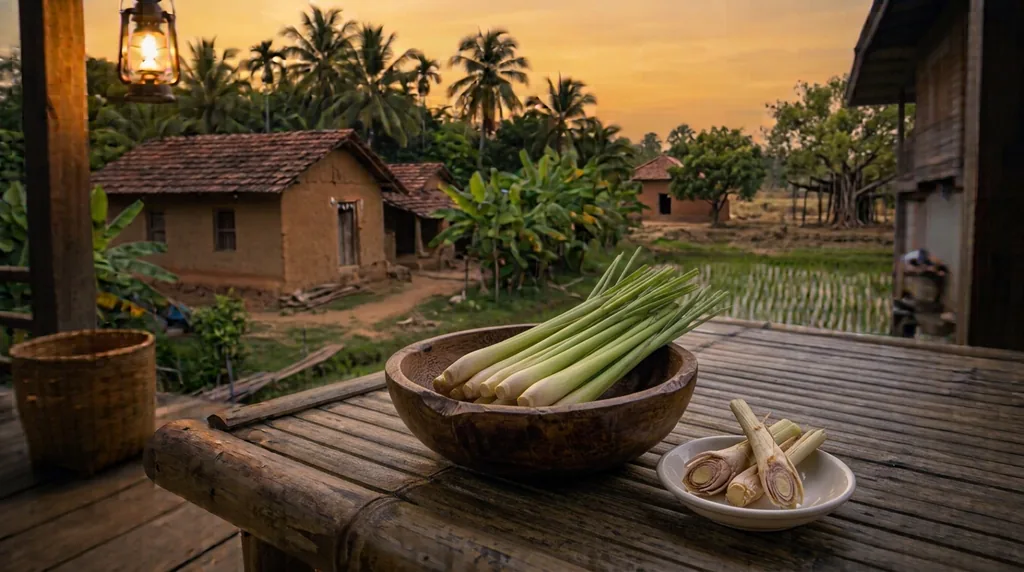
Lemongrass is one of the most common ingredients in the Thai kitchen. In Thailand it grows in almost every garden and is sold in fresh bundles at every market, and you will find it in soups, curry pastes, salads, marinades and even drinks. It is a tall, tough grass, and only the pale, tightly packed lower part of the stalk is used. The outer leaves and green tops are too woody to eat.
The flavour is bright and lemony, but without the sourness of a lemon: fresh, floral and almost gingery. Together with galangal and makrut lime leaves it forms the aromatic trio behind Tom Yum and Tom Kha Gai. It is pounded into nearly every Thai curry paste, from red and green to massaman, rubbed into grilled chicken, and steeped into a refreshing lemongrass tea, nam takrai.
In your kitchenIf the Thai kitchen has a scent, it is lemongrass.
How to use it
Trim and peel
Cut off the root end and the green upper part. Peel away one or two of the tough outer layers until you reach the pale, tender core.
Bruise it for soups
Crush the stalk with the back of a knife or a pestle, then cut it into 5 cm pieces and simmer them in the broth. They flavour the soup but are not eaten.
Slice it thin to eat
For salads and curry pastes, slice the tender lower part paper-thin across the grain, then chop or pound it finely so no fibres remain.
Store it
Wrapped in a damp towel, lemongrass keeps for about two weeks in the fridge. It also freezes well, whole or chopped, for several months.